


2025-03 MIRA Ceti sprak met... Elodie Lesage
** Trefwoorden: Jupitermaan Europa – Europa Clipper – Cryovulkanisme – Zoektocht buitenaards leven – Jet Propulsion Laboratory **
Wie regelmatig al wel eens rondneust op de uitstekende website phys.org komt daar gegarandeerd boeiende artikels tegen uit de wereld van sterren en planeten. Zo verging het ook ons toen we zowaar op 1 april van dit jaar daar konden kennismaken met recent onderzoek over ijsvulkanisme op de grote Jupitermaan Europa.
Om hier meer over te weten te komen, zochten we contact met de Franse Elodie Lesage (°1995) van het gerenommeerde Jet Propulsion Laboratory of JPL die het onderzoek leidde. Zij maakt ook deel uit van het wetenschappelijk team rond de NASA-ruimtesonde Europa Clipper.
Opmerking: de Engelse versie van dit interview staat te lezen onder de Nederlandse tekst.
Note: the English version of this interview can be read under the text in Dutch.

Copyright afbeelding: Elodie Lesage
Hallo Elodie, goedemorgen in Californië. Hartelijk dank dat ik je via Zoom mocht interviewen. Kan je ons vertellen hoe jouw interesse in astronomie ontstond, en meer in het bijzonder in de fascinerende Jupitermaan Europa?
Toen ik begon met mijn studie aan de Sophia-Antipolis Universiteit in Nice, wilde ik meer leren over het heelal, over het klimaat, over zoveel dingen, maar ik had geen concreet idee wat ik in de toekomst wilde doen. Ik wist dat ik onderzoek wilde doen, maar ik wist eigenlijk niet in welk domein. Ik studeerde natuurkunde en voor mijn masterscriptie sloot ik me aan bij een team in het GEOPS-laboratorium in Parijs. GEOPS staat voor Géosciences Paris-Saclay en ik dacht dat ze alleen onderzoek deden naar onze eigen planeet Aarde. Dus ik wist niet dat ze ook een team planetaire wetenschappen hadden. Sterker nog, ik wist op dat moment helemaal niet dat planetaire wetenschappen bestonden. In Parijs ontdekte ik de fascinerende wereld van de planetaire wetenschappen, op het raakvlak van natuurkunde en het onderzoek naar al die betoverende verre planeten in ons zonnestelsel. Dat was echt een openbaring voor mij, en ik was zo enthousiast dat ik het onderwerp van mijn oorspronkelijke stage veranderde in een stage in de planetaire wetenschappen.
Na mijn master ging ik met hetzelfde team verder om te promoveren. Daar raakte ik gefascineerd door Jupiters maan Europa en begon ik mijn onderzoek naar de cryovulkanische activiteit op Europa.
En toen verhuisde je naar de Verenigde Staten?
Ja, ik ben in 2021 voor mijn postdoc naar de VS verhuisd. JPL was de ideale plek om mijn onderzoek naar het modelleren van watertransport door de ijskorst van Europa voort te zetten.
Was het een cultuurshock om naar een ander continent te verhuizen?
Nou, de manier van leven hier is inderdaad heel anders dan hoe we in Frankrijk leven. Dus ik had wat tijd nodig om eraan te wennen. Maar ik vind het er erg leuk, ik hou van Californië met de open geest van de mensen en het heerlijke klimaat.
Het Jet Propulsion Laboratory is een grote naam in het ruimteonderzoek, in de sterrenkunde en ruimtevaart. Kan je een kort beeld schetsen van JPL? Waarom is het zo beroemd?
JPL is het grootste NASA-centrum en heeft ongeveer 6000 mensen in dienst. De meesten van hen zijn ingenieurs, maar er zijn ook veel onderzoekers aan het centrum verbonden. Het bijzondere aan JPL is dat het hele lab multidisciplinair is en dat er veel interdisciplinaire afdelingen zijn. Onderzoekers en ingenieurs werken samen om de meest uiteenlopende ruimtevaartprojecten te realiseren.
Wat ik zo geweldig vind aan JPL, is dat ze me toestonden om aan een aantal technische projecten te werken, veldwerk te doen, veel dingen die ik in een Franse planetaire wetenschappelijke omgeving niet zou kunnen doen. Het voordeel van JPL is dat ze toegang hebben tot al deze middelen en vele andere dingen die de mogelijkheden van kleinere instellingen te boven gaan.
Ik heb drie jaar aan de Europa Clipper gewerkt voordat deze werd gelanceerd, en het ruimtevaartuig werd bij JPL gebouwd. Dus ik kon gewoon naar de cleanroom gaan en het ruimtevaartuig voor me zien, en de mensen die de schroeven en de buizen in elkaar zetten, het ruimtevaartuig testen en alles. Ik verzeker je: dat geeft echt een fantastisch gevoel.

Copyright afbeelding: NASA/JPL
Merk je een andere werkmentaliteit in de VS vergeleken met wat we in Europa kennen?
Ik kan niet echt spreken over de VS in het algemeen, omdat ik alleen hier bij JPL heb gewerkt. Maar één belangrijk verschil is dat ik nu voor een zeer grote organisatie werk, en dat is heel anders dan wat ik in Frankrijk kende, met ons kleine planetaire wetenschapsteam van slechts tien mensen. Hier zijn we met ongeveer 6.000 werknemers met verschillende faciliteiten, werkplekken, onderzoeksdomeinen met verschillende management- en bestuurslagen. Deze bedrijfsstructuur was compleet nieuw voor mij, het duurde even voordat ik eraan gewend was. En na die paar jaar leer ik nog steeds bij over de structuur van het Lab. Het is enorm.
Dus je ervaart niet de intimiteit die je hebt als je met een klein team werkt?
Het klopt dat er mensen drie deuren verderop van mijn kantoor zitten met wie ik nooit heb gesproken, omdat ik ze nauwelijks zie en ik niet met ze samenwerk. Hier bij JPL kun je niet al je buren kennen, dat is niet mogelijk. Maar we hebben ook groepen collega's. En omdat ik aan meerdere projecten werk, maak ik deel uit van meerdere teams, en is er ruimte voor een persoonlijke benadering en vriendschappelijke relaties.
Je onderzoek richt zich op de oceanen in ons zonnestelsel, en in het bijzonder Jupiters grote maan Europa.
Ja, ik bestudeer Europa al sinds mijn promotieonderzoek, dus bijna tien jaar nu – oh mijn god, wat vliegt de tijd…
En jij bent gespecialiseerd in digitale hoogtemodellen. Kan je dit wat toelichten?
We proberen driedimensionale topografische kaarten van het oppervlak van Europa te maken. Als we de geologie van Europa en de geologische kenmerken ervan willen begrijpen, is een betrouwbare weergave van de lokale topografie erg nuttig, zoals we dat op aarde zouden doen met kaarten van bergen, hoogtes, enzovoort.
We proberen dit voor Europa te doen, maar het is een grote uitdaging omdat we met zeer beperkte data werken. Je weet waarschijnlijk dat Galileo, het JPL-ruimtevaartuig dat van 1995 tot 2003 in een baan om Jupiter en zijn vier Galileïsche manen draaide, een probleem had met de antenne. De antenne was niet volledig uitgeklapt, waardoor de hoeveelheid data die NASA van Galileo ontving zeer beperkt was. We hebben slechts een paar honderd afbeeldingen van Europa.
Met innovatieve technieken proberen we maximale informatie uit deze beelden te halen om de driedimensionale topografie van Europa's oppervlak te reconstrueren.
Een andere uitdaging is dat het een zeer reflecterend oppervlak is vanwege het ijs. Als je ijs probeert te belichten, gaat het licht alle kanten op. Het gevolg is dat het erg moeilijk is om de fysica van ijzige oppervlakken te begrijpen, wat het genereren van onze driedimensionale kaarten bemoeilijkt. Ik werk nog steeds met de Galileo-gegevens samen met een team bij JPL om meer informatie te krijgen over mogelijke wateruitbarstingen in het verleden.
Het genereren van deze digitale hoogtemodellen is onderzoek dat je al in Parijs deed?
Ja, het is eigenlijk de helft van mijn doctoraat. De helft van mijn doctoraat bestond uit numerieke modellering van cryovulkanisme en de andere helft uit het genereren van driedimensionale kaarten.
Wat is er zo interessant aan Europa? Waarom al die missies, studies en wetenschappelijke artikelen?
Van de verschillende oceaanwerelden in het zonnestelsel is Europa de meest veelbelovende in de zoektocht naar buitenaards leven. Wat Europa uniek maakt, is dat er een ijsmantel en een oceaan zijn, maar Europa is de enige oceaanwereld in het zonnestelsel die zoveel te maken heeft met zulke intense straling uit zijn omgeving. Hierdoor komt zuurstof vrij uit H₂O aan het oppervlak, dat via verschillende mechanismen door de ijslaag naar de oceaan wordt getransporteerd. Op de bodem van de oceaan vindt hydrothermale activiteit plaats door de enorme getijdenkrachten van Jupiter. In zo'n omgeving zal zuurstof via reductoren energie leveren die leven mogelijk maakt.We proberen te begrijpen hoe de kringloop plaatsvindt met materiaal dat van het oppervlak naar de ondergrond of van de ondergrond naar het oppervlak wordt getransporteerd. Europa heeft in ieder geval veel potentieel. Het oppervlak is het jongste in het zonnestelsel, dus het moet zeer vaak worden vernieuwd. Ook al begrijpen we nog niet helemaal hoe het werkt, er is elke zestig tot negentig miljoen jaar sprake van oppervlaktevernieuwing, dat wil zeggen geologisch gezien is het oppervlak heel jong, maar vinden er op de een of andere manier toch nog veel uitwisselingen plaats.
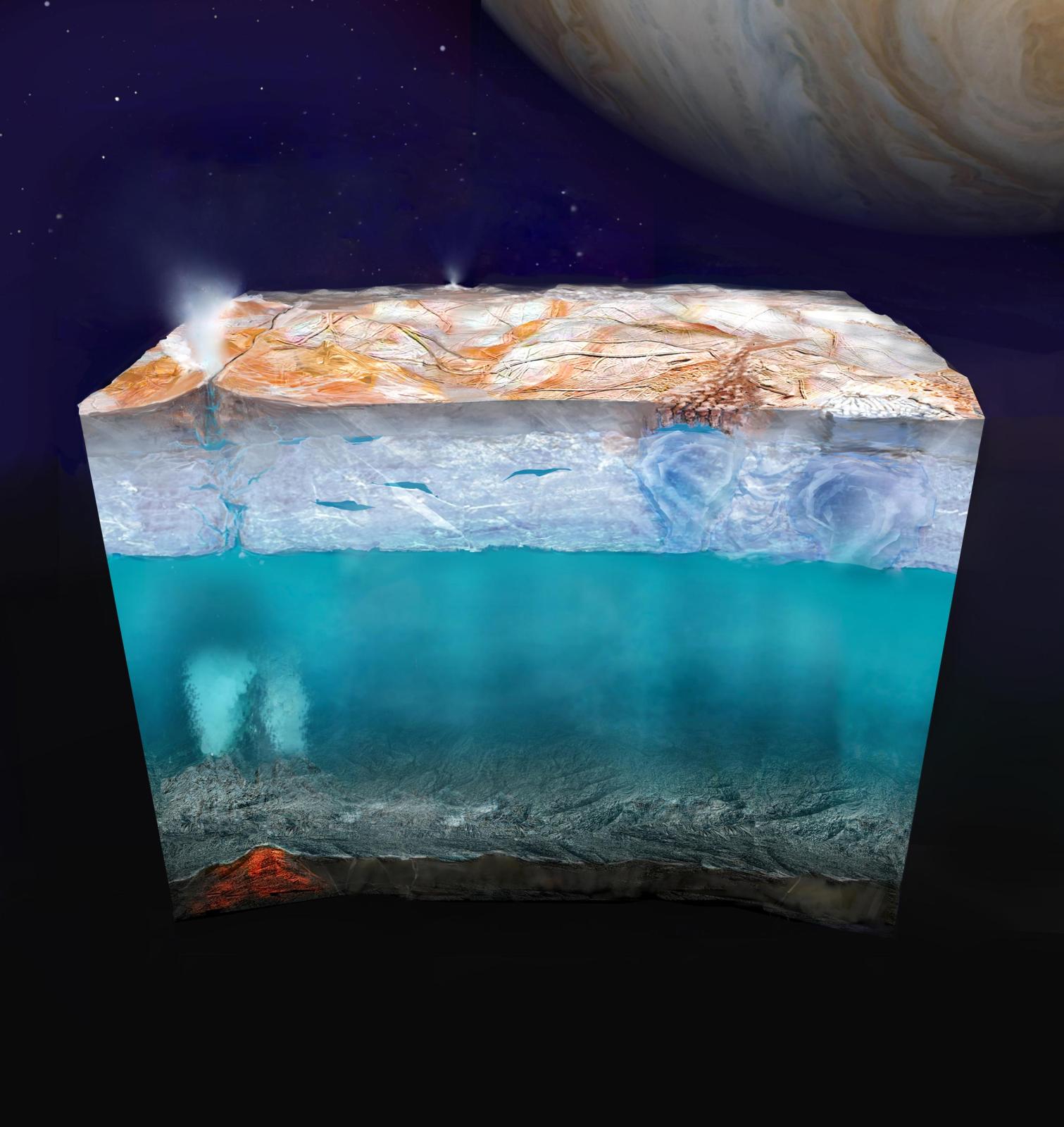
Artistieke voorstelling van wat het inwendige van Europa zou kunnen zijn. Copyright afbeelding: NASA/JPL-Caltech
Wat we momenteel over Europa weten, is grotendeels gebaseerd op waarnemingen van de Galileo-ruimtesonde. Maar klopt het dat de Hubble-ruimtetelescoop bewijs heeft gevonden voor de aanwezigheid van geisers op de ijskorst?
Wat Hubble ontdekte, zijn enkele concentraties H₂O-damp in de kleine atmosfeer rond Europa, maar HST had niet genoeg resolutie om de geiserpluimen daadwerkelijk te zien.
Het is dus niet vergelijkbaar met wat Cassini ontdekte op de Saturnusmaan Enceladus. We weten alleen dat er ergens in de atmosfeer van Europa al lange tijd een verhoogde H₂O-damp aanwezig is, en dat kan verschillende oorzaken hebben: het kunnen uitbarstingen van geisers zijn, maar ook sublimatie van het ijs, of misschien iets anders. Er worden dus verschillende hypothesen geopperd om de concentraties H₂O-damp te verklaren.
Zeer opvallend zijn die roodbruine, lange strepen op het oppervlak van Europa. Wat zijn dat voor dingen?
Alles op het oppervlak van Europa is ijs. Deze strepen zijn dubbele richels die zich tientallen kilometers uitstrekken. Ze zijn zeer mysterieus en uniek; we zien niet veel dubbele richels die enig ander oppervlak in het zonnestelsel bedekken.
Er zijn al verschillende hypothesen geformuleerd om te proberen te verklaren hoe ze ontstaan. Sommige studies suggereren dat ze zouden kunnen ontstaan door wrijving van de getijden, wat zou kunnen leiden tot smelten in de ondergrond. Er zouden dus grote bellen vloeibaar water in de ondergrond moeten zitten. De roodbruine kleur van deze strepen op Europa wordt veroorzaakt door mineralen, mogelijk gehydrateerde zouten zoals magnesiumsulfaat of zwavelzuur, vermengd met het waterijs. Deze mineralen zijn via scheuren en richels naar het oppervlak gekomen.
Er is een onderzoeksteam dat in Groenland iets soortgelijks als deze richels op Europa heeft gevonden. Ze ontdekten een soort dubbele rug in Groenland, en na radarwaarnemingen ontdekten ze water in de ondergrond.
Er is geopperd dat het water zou kunnen zijn, maar het zou ook gewoon wrijving of tektonische activiteit kunnen zijn, of een ander mechanisme dat we nog niet kennen. Maar Europa Clipper zal het ons vertellen.

Copyright afbeeldingEuropa: NASA/JPL. Copyright afbeelding Groenland: DEM courtesy of the Polar Geospatial Center
Wetenschappers ontdekten ook zogenaamde reticulae in het ijs. Wat zijn dat eigenlijk?
Het zijn ook geologische verschijnselen. We hadden het net over de lange dubbele richels, die 'lineae' worden genoemd. De 'lenticulae' zijn kleinere ronde of ellipsoïde vlekken. Het kunnen zowel verhoogde topografieën als kuilen zijn, en we proberen nog steeds te begrijpen hoe ze ontstaan. Misschien ontstaan ze door grote bellen vloeibaar water die uitbarsten, bevriezen of instorten en zo de ijslaag afvloeien, waardoor een kuil ontstaat? Er zijn verschillende vormingsmechanismen voorgesteld en de meeste daarvan hebben te maken met vloeibaar water. We zijn dus hoopvol dat we met de komende ruimtemissies vloeibaar water in de buurt van al deze geologische verschijnselen kunnen detecteren.
En het goede nieuws is: met JUICE van ESA en Europa Clipper van NASA zijn er twee ruimtesondes onderweg om onderzoek te doen naar Europa. Zal er nauwe samenwerking zijn tussen de twee ruimtevaartuigen?
Inderdaad. En ondanks het feit dat beide missies pas begin volgend decennium ter plaatse zullen zijn, werken we nu al samen. Er is een team dat is samengesteld uit medewerkers van JUICE en Europa Clipper om de wetenschappelijke prestaties die we kunnen leveren met de combinatie van beide missies te maximaliseren.
In welke zin kan JUICE interessant zijn voor Europa Clipper?
Omdat Europa één van de drie studieobjecten van JUICE is. Het zijn beide flyby-missies, waarbij ze rond Jupiter cirkelen en vervolgens langs Europa vliegen. Het verschil is dat JUICE inderdaad niet alleen op Europa gericht is, maar ook Ganymedes en Callisto zal observeren. Het is dus een bredere missie met als doel de drie grote ijsmanen van Jupiter en ook het Jupiterstelsel te verkennen, terwijl Europa Clipper volledig op Europa gericht is. JUICE zal slechts twee flybys van Europa maken, terwijl Europa Clipper nominaal vijftig flybys van Europa zal maken. Maar wat erg interessant is, is dat ze vrijwel tegelijkertijd bij Europa zullen zijn. En er is één flyby waarbij Europa Clipper en JUICE hun flyby maken met slechts een paar uur ertussen. Dat betekent dat we Europa vanuit twee hoeken tegelijk kunnen zien, wat erg spannend is.
De baan van Europa Clipper is heel bijzonder, nietwaar? Soms bevindt het ruimtevaartuig zich heel dicht bij het oppervlak van Europa en dan weer ver weg.
Precies. Europa Clipper draait in een elliptische baan rond Jupiter om de intense straling dicht bij Jupiter, die de omgeving zeer moeilijk maakt voor het ruimtevaartuig, zoveel mogelijk te vermijden. Als we te lang dicht bij Europa zouden blijven, zou het ruimtevaartuig snel ten onder gaan. Daarom worden elke keer dat we Europa naderen alle instrumenten ingeschakeld om waarnemingen te doen en foto's te maken. Vervolgens snelt Europa Clipper naar een gebied waar de sonde veilig is voor de straling, en van daaruit kunnen de verzamelde gegevens veilig naar de Aarde worden teruggestuurd.
Wat is de rol van de vulkanische Io in de fysica van Europa?
Io is erg belangrijk vanwege de vele actieve vulkanen. Io stoot continu vulkanisch materiaal de ruimte in, waardoor er een brede torus van plasma ontstaat in de stralingsomgeving van Jupiter. Het zijn deze deeltjes, versneld door de magnetosfeer van Jupiter, die het oppervlak van Europa gaan oxideren: ze bombarderen letterlijk het ijsoppervlak en dissociëren moleculen zoals O₂ en H₂O om de oxiderende ionen in de context van Europa te creëren. We hebben dus Io nodig voor dit alles.
Jij bent gespecialiseerd, Elodie, in het modelleren van cryovulkanisme op Europa en hoe watertransport daar door de ijskorst plaatsvindt. Kan je ons daar iets over vertellen?
Ik werk aan de cryovulkanische activiteit op Europa, maar zoals ik al eerder zei, hebben we dit nog niet direct waargenomen. Het is niet vergelijkbaar met Enceladus, waar we de geisers daadwerkelijk hebben gezien. Op basis van waarnemingen van de Galileo-sonde en de HST zien we verschillende dingen aan het oppervlak van Europa die verklaard zouden kunnen worden door uitbarstingen. Maar we zijn er niet helemaal zeker van of dit echt het geval is op Europa. Een belangrijke disclaimer, toch?
Mijn wetenschappelijke werk omvat, naast verschillende andere dingen waar ik mee bezig ben – eigenlijk werk ik te hard – het ontwikkelen van modellen die laten zien hoe het transport van vloeibaar water door de ijskorst naar het oppervlak plaatsvindt. Ik doe dit met numerieke simulaties, en vervolgens kijk ik naar de signaturen die we aan het oppervlak kunnen zien als dit soort uitbarstingen plaatsvinden. Hoeveel volume is er uitgebarsten? Op welk tijdstip? Wat is de samenstelling?
Op sommige plaatsen ontdekken we een thermische anomalie aan het oppervlak, een verhoogde temperatuur van het ijs. Dat kan erop wijzen dat er vloeibaar water onder het oppervlak zit, waardoor het ijs warmer zou zijn. Dat zijn verschijnselen die we aan het oppervlak kunnen waarnemen.
Al dit soort dingen maken deel uit van mijn onderzoek.
Heel fascinerend.
Inderdaad. En ik hoop dat deze modellen kunnen bijdragen aan een beter begrip van wat er werkelijk gebeurt zodra we aan de slag kunnen met de waarnemingen van de Europa Clipper.
De volgende grote stap is het ontdekken van sporen in de context van Europa die wijzen op mogelijk buitenaards leven, toch?
Europa Clipper is geen missie om leven te detecteren, het is wel een missie om na te gaan of op Europa alle voorwaarden voor leven aanwezig zijn: vloeibaar water, chemie en energie.
We weten natuurlijk dat er water is, maar hoeveel, hoe diep is de oceaan, wat is de samenstelling, enzovoort. We willen graag antwoord op deze vragen. We gaan proberen voedingsstoffen en andere chemische bouwstenen te vinden. En is er ergens in het binnenste van Europa een energiebron?
Maar we gaan geen monsters nemen van het oppervlak op zoek naar oceaanmateriaal, we gaan geen microscopische analyses uitvoeren en dat soort dingen. Er zijn wereldwijd teams die onderzoeken hoe we op Europa naar leven kunnen zoeken, maar dat is niet wat de Europa Clipper gaat doen. We verwachten dan ook niet dat we met deze ruimtemissie leven op Europa zullen ontdekken.
Wat is jouw persoonlijke idee over het ontdekken van buitenaards leven op Europa?
Wat kan ik zeggen? Als er leven in het zonnestelsel is, denk ik dat Europa onze beste kans is. Maar dat is slechts mijn standpunt, en ik ben misschien bevooroordeeld.
Is de Europa Clipper uitgerust om waterdamp te analyseren in geval van een cryovulkaanuitbarsting terwijl het ruimtevaartuig passeert?
Dat zou een groot toeval zijn, maar ja, er is een massaspectrometer aan boord van de Europa Clipper, een detector voor geladen deeltjes en een stofanalysator. Dus in totaal zijn er drie instrumenten die deeltjes in de atmosfeer van Europa kunnen detecteren. De Europa Clipper is een behoorlijk compleet ruimtevaartuig, het is een grote missie, mogen we wel zeggen.

Verbeterde beelden van de Galileosonde tonen een gedetailleerd oppervlak. Copyright afbeelding: NASA/JPL/DLR
Zijn er al ideeën voor een opvolger, een missie die op het oppervlak van Europa zou landen of die zich een weg zou smelten door de ijskorst en vervolgens in de oceaan zou duiken?
Natuurlijk hebben we ideeën en ik werk ook aan plannen hiervoor, maar momenteel is er nog niets door NASA geselecteerd of zelfs maar aanbevolen voor de nabije toekomst. Laten we eerst eens kijken wat JUICE en Europa Clipper ons kunnen leren over de omgeving van Europa. En op basis van die bevindingen kunnen we dan teruggaan en landen.
Het is dus geen missie die in de nabije toekomst zal plaatsvinden, maar er zijn wel teams die werken aan de ontwikkeling van technologieën voor deze volgende missie naar Europa.
En in die context ben ik ook betrokken bij een project van JPL waar we ongeveer een maand veldwerk zullen doen in Alaska. We zullen een prototype testen van een sonde uitgerust met verwarmde boren. We noemen het een cryobot. Het is in feite een metalen cilinder waarin we een verwarmingssysteem installeren. Vervolgens plaatsen we die op een ijsoppervlak en laten we de zwaartekracht zijn werk doen. Op die manier bereikt het apparaat de bodem. We rusten het apparaat ook uit met pompen die stalen kunnen nemen en instrumenten om het water te analyseren. Later zou een soortgelijke sonde op Europa het ijs en de oceaan kunnen analyseren terwijl het daalt. We zijn twee jaar geleden al naar Alaska geweest, ter voorbereiding op de tests die we nu gaan uitvoeren.
Dus je zult waarschijnlijk leven ontdekken in een meer in Alaska?
Ja, precies.
De eerste flyby van de Europa Clipper langs Europa zal pas in het voorjaar van 2031 plaatsvinden, dat is nog lang wachten. Ben je niet ongeduldig, Elodie?
Ik kan inderdaad niet wachten tot ik de eerste foto's met zeer hoge resolutie zie, de eerste radarmetingen ontvang, enzovoort. Dankzij deze en alle andere instrumenten Zullen we door de ijslaag heen kunnen kijken en zoveel leren over de vele processen die zich daar afspelen. En dat is heel spannende wetenschap. Nog zes jaar te gaan…
Maar al met al gaat de tijd snel.
Klopt. Ik herinner me nog dat ik bezig was met mijn promotieonderzoek en dacht dat het nog twaalf jaar zou duren voordat Europa Clipper echt onderzoek naar Europa kon doen. En nu is het nog maar zes jaar.
Wij kijken ook vol verwachting uit naar wat JUICE en Europa Clipper te bieden hebben. Veel succes met je verdere onderzoek en projecten, Elodie, en hartelijke dank voor het fascinerende interview.
Tekst: Francis Meeus, juni 2025
***********************************************************************************
Interview in English
Anyone who regularly browses the excellent website phys.org is guaranteed to come across fascinating articles from the world of stars and planets. That was also the case when, on April 1 of this year, we were introduced to recent research on ice volcanism on Jupiter's large moon Europa.
To find out more, we contacted the French Elodie Lesage (°1995) from the renowned Jet Propulsion Laboratory or JPL who led the research. She is also part of the scientific team around the NASA space probe Europa Clipper.
Hello Elodie, good morning to you in California. Thank you very much for letting me interview you via Zoom. Can you tell us how you became interested in astronomy and more in particular in the fascinating Jupiter moon Europa?
When I started my studies at the Sophia-Antipolis University in Nice, my aim was to learn more about the universe, about climate, about so many things, but I had no concrete idea what I wanted to do in the future. I knew that I wanted to do research, but I really didn’t know in what domain. I studied physics and for my master thesis I joined a team at the GEOPS laboratory in Paris. GEOPS stands for Géosciences Paris-Saclay and I thought they only did research about our own planet Earth. So I didn’t know they had a planetary sciences team as well. And in fact I didn’t know that planetary sciences existed at all at that moment. In Paris I discovered the fascinating world of planetary sciences at the intersection of physics and the research of all those enchanting far away worlds in our solar system. That was really a revelation for me, and I was so enthusiastic that I changed the subject of my original internship into a planetary science internship.
When I finished my master’s degree I continued with the same team to obtain my PhD. It is there that I got fascinated by Jupiter’s moon Europa and that I started my research on the cryovolcanic activity on Europa.
And then you moved to the United States of America?
Yes, I moved for my postdoc to the US in 2021. JPL was the ideal place to continue my research on modelling the transport of water through the ice crust of Europa.
Was it a cultural shock to move to another continent?
Well, the way of life here is quite different from how we live in France, that is true. So I needed some time to get used to it. But I really like it, I love California with the open mind of people and the wonderful climate.
The Jet Propulsion Laboratory is a big name in space science, astronomy, spaceflight. Can you tell a few things about JPL? Why is it so famous?
JPL is the biggest NASA centre, it employs about 6.000 people. Most of them are engineers, but there are also many researchers associated with the center.Very special about JPL is that the whole lab is multidisciplinary and there is a lot of cross disciplinary section going on. Researchers and engineers work together to realise the most diverse space projects.
What I love about JPL is that they allowed me to work on some engineering projects, to do field work, plenty of things I would not be able to do in a French planetary science environment. The advantage of JPL is that they have access to all these resources and many other things that exceed the capabilities of smaller institutions.
I worked on Europa Clipper for three years before it launched, and the spacecraft was being built at JPL. So I just could go to the clean room and see the spacecraft in front of me and see the people assembling the screws, the pipes, testing the spacecraft and everything. I assure you: that really gives a fantastic feeling.
Do you notice another work mentality in the US compared to what we know in Europe?
I can’t really talk for the US in general as I have only worked here at JPL. But one significant difference is that I now work for a very large organization, and that is quite different from what I knew in France with our small planetary science team of only ten people. Here we are with about 6.000 employees with several different facilities, workspaces, research domains with several levels of management and administration. This corporate structure was completely new for me, it took me a while to get used to it. And after these few years I am still learning about the structure of the Lab. It is huge.
So you don't experience the intimacy that you do have when you work with a small team?
It is true that there are people three doors away from my office that I never talked to because I barely see them and I don’t work with them. Here at JPL, you just can’t know all your neighbours, that is not possible. But we also have groups of coworkers. And since I work on several projects, I am part of several teams, and there is room for a personal approach and friendly relations.
Your research focuses on the ocean worlds in our solar system and in particular Jupiter's large moon Europa.
Yes, I have been studying Europa since my PhD, so almost ten years now – oh my god, time flies…
And you are specialized in Digital Elevation Models, can you explain this a little bit?
We try to create three-dimensional topographical maps of Europa’s surface. If we want to understand the geology of Europa and the geological features on its surface, it is very useful to have a reliable representation of the local topography, as we would do on Earth with maps of mountains, elevations, etcetera.
We try to do this for Europa, but it is very challenging because we work with very limited data. You probably know that Galileo, the JPL spacecraft that orbited Jupiter and its four Galilean moons from 1995 to 2003, had an issue with its antenna. The antenna didn’t deploy completely, and that is the reason that the amount of data NASA received from Galileo was very limited. We only have a few hundred images of Europa.
We try with innovative techniques to get the maximum information out of these images to reconstruct the three-dimensional topography of Europa’s surface.
Also challenging is the fact that it is a very reflective surface because of the ice. If you try to illuminate ice, light goes in all directions. The consequence is that it is very hard to understand the physics of icy surfaces, which complicates the generation of our three-dimensional maps. I am still working on the Galileo data with a team at JPL to get more information on potential past water eruptions.
Generating these Digital Elevation Models is research that you were already doing in Paris?
Yes, it is half of my PhD actually. Half my PhD was numerical modelling of cryovolcanism and the other half was generating three-dimensional maps.
What is so interesting about Europa? Why all those missions and studies, scientific articles?
Among the different ocean worlds in the solar system, Europa is the most promising in the search for extraterrestrial life. What makes Europa unique is that there is an ice shell and an ocean, but Europa is the only ocean world in the solar system that has so much to do with such intense radiation from its environment. This causes oxygen to be released from H2O at the surface, which is transported via various mechanisms through the ice layer into the ocean. At the bottom of the ocean, hydrothermal activity occurs due to the enormous tidal forces of Jupiter. In such an environment oxygen will provide energy through reductants that make life possible.
We are trying to understand how the cycling happens with material that is transported from the surface to the subsurface or from the subsurface to the surface. In any case, Europe has a lot of potential. The surface is the youngest in the solar system, so it must be renewed very often. Even if we don’t completely understand yet how it works, there is a surface renewal every sixty to ninety million years, that means geologically speaking a very young surface with a lot of exchanges somehow.
What we currently know about Europa is largely based on observations from the Galileo spacecraft. But is it correct that the Hubble Space Telescope found evidence for the presence of geysers on the ice crust?
What Hubble discovered are some concentrations of H2O vapor in the tiny atmosphere around Europa, but HST didn’t have enough resolution to actually see geyser plumes.
So it's not like what Cassini discovered on Saturn's moon Enceladus. We just know that there is increased H2O vapor somewhere in Europa’s atmosphere for a long time, and that could have several origins: it could be eruptions of geysers, but it also could be sublimation of the ice or maybe something else. So there are different hypothesizes proposed to explain the concentrations of H2O vapor.
Very striking are those red-brown long streaks on the surface of Europa. What kind of things are those streaks?
Everything on the surface of Europa is ice. These streaks are double ridges that propagate for tens of kilometers. They are very mysterious and unique, we don’t see many double ridges covering any other surface in the solar system.
Several hypotheses have already been formulated to try to explain how they form. Some studies propose that they could form due to friction from the tides which could create some melting in the subsurface. So there would be pockets of liquid water in the subsurface. The reddish-brown color of these streaks on Europa is caused by minerals, possibly hydrated salts such as magnesium sulfate or sulfuric acid, mixed with the water ice. These minerals have come to the surface through cracks and ridges.
There is a research team that found something similar to these ridges on Europa in Greenland. They discovered a kind of double ridge in Greenland, and after making radar observations they detected water in the subsurface.
So it has been proposed that it could be water, but it could also just be friction or tectonic activity or some other mechanism that we don't know yet. But Europa Clipper will tell us.
Scientists also discovered so-called ‘reticulae’ in the ice, what are those things?
They are geological features as well. We just talked about the long double ridges, they are called ‘lineae’. The ‘lenticulae’ are smaller round or ellipsoid patches, they can be either elevated topography or pits, and we are still trying to understand how they form. Maybe they arise from pockets of liquid water that erupt or freeze or collapse to drain down the ice shell which creates a pit? Several formation mechanisms have been proposed and most of them involve liquid water. So we are hopeful with the upcoming space missions that we can detect liquid water nearby all these geological features.
And the good news is: with JUICE from ESA and Europa Clipper from NASA, two space probes are actually on their way to conduct research on Europa. There will be close cooperation between the two spacecraft?
Indeed. And despite the fact that both missions will not be in place until early next decade, we are already collaborating. There is a team that is joined between JUICE and Europa Clipper to maximize the science we can do with the cross section of the two missions.
In what sense can JUICE be interesting for Europa Clipper? Because Europa is only one of the three study objects of JUICE.
They are both flyby missions, orbiting Jupiter and then do flybys of Europa. The difference is that JUICE indeed is not only focused on Europa, it is also going to do observations of Ganymede and Callisto. So it is a broader mission with the aim to explore the tree big icy moons of Jupiter and the Jovian system, where Europa Clipper is fully focused on Europa.
JUICE will only do two flybys of Europa, Europa Clipper nominally is going to do fifty flybys of Europa. But what is very interesting is that they will be at Europa pretty much at the same time. And there is one flyby where Europa Clipper and JUICE are going to do their flyby with only a few hours apart. That means that we are going to be able to see Europa from two angles at the same time, which is very exciting.
The orbit of Europa Clipper is very particular, isn’t it? Sometimes the spacecraft is very close to the surface of Europa and then it is far away.
Exact. Europa Clipper will orbit Jupiter in an elliptical orbit to avoid as much as possible the intense radiation close to Jupiter that makes the environment very harsh for the spacecraft. If we stayed close to Europe for too long, the spacecraft would soon come to an end. That is why every time we pass close to Europa all instruments are turned on to do observations and make pictures. Then Europa Clipper rushes to an area where the probe is safe from the radiation, and from there the collected data can be safely sent back to Earth.
What is the role of the volcanic Io on the physics of Europa?
Io is very important because of the many active volcanoes. So Io ejects continuously volcanic material into space, creating around itself a wide torus of plasma in the radiative environment of Jupiter’s magnetic field. It are these particles, accelerated by Jupiter’s magnetosphere, that are going to oxidize Europa’s surface: they literally bombard the ice surface and dissociate molecules like O2 and H2O to create the oxidizing ions in the context of Europa. So we need Io for all this.
You are specialized, Elodie, in modeling cryovolcanism on Europa and how water transport occurs there through the ice crust. Can you tell us something about that?
I work on the cryovolcanic activity at Europa, but as I said before, this is not something we have directly observed yet. It's not comparable to Enceladus, where we actually have seen the geysers. Based on observations from the Galileo probe and the HST, we see several things at the surface of Europa that could be explained by eruptions. But we are not absolutely sure that this is really the case at Europa. An important disclaimer, isn’t it?
My scientific work includes, besides various other things that I am working on - actually I work too hard - developing models showing how the transport of liquid water happens through the ice shell onto the surface. I do this with numerical simulations, and then I look at the signatures that we can see on the surface if these kind of eruptions happen. How much volume is erupted? At what time? What is the composition?
In some places we discover some thermal anomaly at the surface, an increased temperature of the ice. That may be an indication that there is liquid water under the surface, the reason why the ice would be warmer. Those are phenomena that we can observe at the surface.
All these kind of things are part of my research.
Very fascinating.
It really is. And I hope that these models can contribute to a better understanding of what really happens once we can start working with the observations from Europa Clipper.
The next big step is to discover traces in the context of Europa that point to possible extraterrestrial life, right?
I doubt that there would not be before a long time I think. But Europa Clipper is not a life detection mission, it is a habitability mission. Our aim is to see if on Europa all the conditions to sustain life are present: liquid water, chemistry, and energy.
We know of course that there is water, but how much, how deep is the ocean, what is the composition, etcetera. We would like these questions to be answered. We are going to try to find nutrients and other chemical building blocks. And is there some kind of energy source somewhere in the interior of Europa?
But we are not going to sample the surface looking for ocean material there, we are not going to do microscopic analysis and these kind of things. There are teams across the world that try to investigate how we can look for life at Europa, but that is not what Europa Clipper will do, so we are not expecting to discover life at Europa with this space mission.
What is your personal idea about discovering extraterrestrial life on Europa?
What can I say? If there is life in the solar system, I think Europa is our best bet. But that is just my point of view, and I may be biased.
Is Europa Clipper equipped to analyze water vapor in the event of a cryovolcano eruption as the spacecraft passes by?
That would be a great coincidence but yes, there is a mass spectrometer onboard of Europa Clipper, a charged particle detector and a dust analyser. So in the whole three instruments that are able to capture particles in the atmosphere of Europa. Europa Clipper is a pretty complete spacecraft, it is a big mission we may say.
Are there already ideas for a successor, a mission that would land on the surface of Europa or one that would melt its way through the ice crust and then dive into the ocean?
Of course we have ideas and I am also working on plans in this regard, but currently there is nothing that is either selected by NASA yet or even recommended for the near future. Let us first see what JUICE and Europa Clipper can learn us what the environment of Europa is like. And based on those findings we can then go back and land.
So it is not a mission that will happen in the near future, but there are indeed teams that work on developing technologies for this next mission to Europa.
And in that context I am also involved in a project of JPL where we will do about a month of fieldwork in Alaska. We will test a prototype of a probe equipped with heated drills. We call it a cryobot. It is basically a cylinder of metal in which we install a heating system. Then we put it on a surface of ice and then we let gravity do its thing. This way the device will reach the bottom. We also equip the device with sampling pumps and instruments to analyse the water. Later on Europa a similar probe would be able to analyse the ice and the ocean as it descends. We went already to Alaska two years ago, that was in preparation for the tests we are going to perform now.
So you will probably discover life in a lake of Alaska?
Yes, exactly.
Europa Clipper’s first flyby of Europa won't happen until spring 2031, that's still a long time to wait. Aren't you impatient, Elodie?
I am indeed very impatient to see the first very high resolution pictures, to receive the first radar measurements, etcetera. Thanks to these and all the other instruments we will be able to look through the ice layer and learn so much about the many processes that take place there. And that is very exciting science.
Only six more years…
But all in all time goes by quickly.
Indeed, I remember that I was doing my PhD and thought there were still twelve years before Europa Clipper could really start researching Europa. And now it is only six years to go.
We are also looking forward with great expectation to what JUICE and Europa Clipper will have to offer. Good luck with your further research and projects, Elodie, and thank you very much for the fascinating interview.
Text: Francis Meeus, June 2025